If you’ve ever driven past a power line crossing a river, a mountain valley, or a rural backroad, chances are you’ve spotted a spool insulator. Those stout, cylindrical units mounted on wooden or metal utility poles, strung between wires, look simple enough—but for years, I’ve heard the same question from clients, line crews, and even fellow suppliers: Do spool insulators conduct electricity? As someone who’s spent the last 12 years working in spool insulator manufacturing and supply, I can tell you this question isn’t just a trivial one. It’s the foundation of what we do. Let’s break this down, cut through the myths, and explain how a part that looks like a heavy ceramic donut keeps the power flowing safely. Spool Insulators
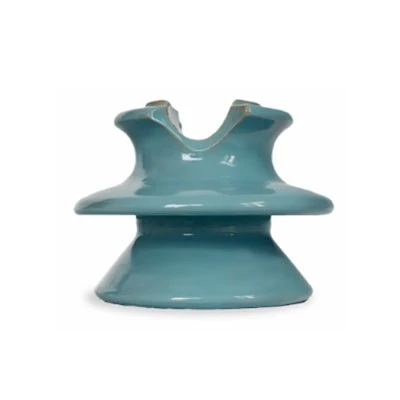
First, let’s get a quick refresher on what insulators do, and what “conduct electricity” actually means. Electricity needs a path to flow, right? It’s why if you touch a live power line, current moves through your body to the ground. An insulator is a material that blocks that path—so it doesn’t let current pass through it. Conductors are the opposite; copper, aluminum, even water (when it’s not pure) let electrons move freely. So, in theory, spool insulators should not conduct electricity. But as with most things in the power industry, theory only goes so far.
Let’s start with what spool insulators are made of. For most of their history, spool insulators were ceramic—porcelain, to be exact. Porcelain is a popular insulator material because it’s cheap, durable, and has extremely high electrical resistance when it’s new, clean, and dry. Resistance is the measure of how much a material opposes current flow; porcelain has a resistance in the trillions of ohms, which is why it’s such a good insulator. But here’s the catch: porcelain isn’t indestructible. It can crack, chip, or get dirty over time. That’s why many modern spool insulators use silicone rubber, a polymer that’s flexible and resistant to weather, but still has high electrical resistance when properly formulated.
So why would anyone think a spool insulator conducts electricity? The short answer is: when they’re not maintained, or when conditions go extreme. I remember a call I got three years ago from a line crew in western Kansas. They were dealing with frequent power outages on a stretch of line that used our spool insulators, and they suspected the insulators were the problem. When they climbed the pole, they found the spool insulators were coated in a thick layer of dust and fertilizer residue from the nearby farm fields. That residue is conductive. Pure water is only slightly conductive, but when it mixes with dust, salt, fertilizer, or pollution, it creates a thin layer of moisture on the insulator’s surface. That layer acts like a tiny bridge for electricity to flow from the power line, through the insulator, to the utility pole, and to the ground—causing what’s called a leakage current.
Leakage current is the key here. It’s not the same as the full current that flows through power lines, but it’s enough to cause small faults, energy loss, or even outages if it’s bad enough. The good news is that modern spool insulators are designed to combat this. Porcelain spool insulators have a glazed surface that sheds dirt better, and silicone rubber spool insulators have hydrophobic properties—meaning they repel water, so that conductive layer of moisture doesn’t form as easily. I’ve tested this myself: if you spray a silicone spool insulator with water, the beads of water roll right off, instead of spreading into a thin film. That small difference makes a huge impact on preventing leakage current.
Another common misconception: what about when insulators are damaged? A small chip in a porcelain spool insulator might not seem like a big deal, but if that chip exposes the inner core (which is usually made of a different material, sometimes with metal parts for mounting), that can create a path for current to flow. Wait, but even a cracked insulator—does it conduct? Not always, unless the crack is filled with conductive material like water or dirt. We had a client in Texas a few years ago who had a hailstorm that cracked a few of our porcelain spool insulators. Instead of replacing them right away, they monitored the leakage current and found that the cracks were dry, so there was no conductivity. They swapped them out during their next scheduled maintenance, no outages caused. That’s why regular inspections are so important with any insulator, not just spool types.
Let’s also talk about the difference between flashover and conduction, because this is where a lot of people mix things up. Flashover is when electricity jumps over the surface of an insulator, instead of going through it. Spool insulators are designed with long, curved surfaces (the “spool” shape, with the grooved area where the power wire sits) to increase the distance the electricity has to jump. That’s called the creepage distance. For example, a standard medium-voltage spool insulator (used for lines that carry 15,000 to 35,000 volts) has a creepage distance of around 10 inches or more. That means electricity has to travel 10 inches along the insulator’s surface to jump from the wire to the pole. If the insulator is clean and dry, that jump is impossible, so no flashover, no conduction. But if the surface is covered in dirt that reduces the effective creepage distance, or if there’s a lot of moisture, flashover can happen. Again, that’s not the insulator itself conducting—it’s the path along its contaminated surface.
I’ve also fielded questions about low-voltage spool insulators, like the ones used for residential service lines or fence wiring. Do those conduct electricity? The same rules apply, just on a smaller scale. Residential lines carry 120 or 240 volts, which is much lower than transmission lines, so spool insulators for these applications are smaller, with shorter creepage distances, but still designed to block conductivity. I remember a time a homeowner called me because their fence line (which we’d supplied spool insulators for) was “leaking electricity” into their dog’s pen. When we showed up, we found that the insulators were old, cracked, and covered in pine sap. The sap and rain created a conductive path, so the low-voltage current was flowing through that layer to the metal fence posts and into the ground. We replaced the old spool insulators with new silicone ones, and the problem was solved. No surprise conduction, just old, dirty parts doing what old, dirty parts do.
Now, let’s get into the science behind why insulators don’t conduct electricity under normal conditions. All materials have a dielectric strength, which is the maximum electric field they can withstand before breaking down (i.e., becoming conductive). Porcelain has a dielectric strength of around 100 kV per inch, which means it can handle up to 100,000 volts per inch before it starts to break down. Silicone rubber is a bit lower, around 40 kV per inch, but that’s still more than enough for almost all spool insulator applications. Transmission lines can carry up to 765,000 volts, and their insulators (usually long strings of porcelain or silicone discs) are sized to have enough total dielectric strength to handle that voltage. A single spool insulator for a transmission line is built with multiple layers of material, so even if one layer has a flaw, the others provide protection.
Of course, extreme conditions can push even the best insulators. I’ve heard of cases where spool insulators in desert areas with extremely high temperatures had issues, or where insulators near coastal areas were exposed to salt spray for years. Salt is highly conductive, so even small amounts on an insulator’s surface can build up over time and create a conductive layer. That’s why we supply “salt-resistant” spool insulators for coastal clients—they have an extra thick glaze on porcelain, or a special formulated silicone rubber that repels salt better. We tested one set of these insulators last year in a lab, spraying them with salt water for 1,000 hours straight, and found the leakage current was 90% lower than standard spool insulators. That’s the kind of engineering that answers the original question: spool insulators don’t conduct electricity, but good ones are designed to withstand conditions that would make cheap ones fail.
I should also mention that the idea that all insulators are perfect non-conductors is a myth that even some industry veterans buy into. There’s no such thing as a perfect insulator—all materials will conduct a tiny amount of current, even under normal conditions. That’s called leakage current, and it’s usually measured in microamps (millionths of an amp), which is so small it doesn’t cause any problems. For context, a typical LED light uses about 10 milliamps, which is 10,000 microamps. So the leakage current from a good spool insulator is 1/10,000th of what an LED uses. That’s negligible, and not something anyone has to worry about under normal operation. The problem only arises when that tiny leakage current jumps to a level that matters, which is almost always from contamination or damage, not the insulator’s inherent properties.
As a spool insulator supplier, this is exactly why we emphasize quality over cost. We’ve seen too many projects where contractors went with the cheapest spool insulators, cut corners on material quality or glaze, and ended up with more outages, higher maintenance costs, and more callbacks. Last year, a solar farm project in Arizona contacted us because their initial spool insulators were failing after 18 months, causing frequent tripping of their solar inverters. They’d bought insulators from a supplier that used low-grade porcelain with a thin glaze. The desert dust and high UV rays had worn through the glaze, leaving the insulator surface porous and prone to contamination. We supplied them with our UV-stabilized silicone spool insulators, and in the year since installation, they’ve had zero related outages. That’s the difference between a product that’s engineered to keep electricity from conducting, and a cheap knockoff that can’t hold up.
Let’s wrap this up with a clear answer to the original question: Do spool insulators conduct electricity? Under normal, clean, dry conditions—no. They are specifically manufactured with high-resistance materials and design features to block the flow of electricity. Under extreme, poorly maintained, or damaged conditions—they can develop small leakage currents, but that’s not the same as the insulator itself conducting electricity. It’s the environment interfering with the insulator’s ability to do its job.

I’ve been in this industry long enough to know that customers don’t just want a technical answer—they want confidence that their power lines will work when they need them. That’s why we test every batch of our spool insulators for dielectric strength, creepage distance, and resistance to contamination. We work with line crews, project managers, and utility companies to match the right insulator to their specific environment, whether that’s a farm in the dust plains, a coastal power plant, or a suburban residential area. If you’re working on a project and have questions about spool insulators, or need to source high-quality units that are built to last in real-world conditions, our team is here to help. We understand that every outage costs time, money, and frustration, and that starts with the right insulator to keep electricity flowing where it needs to go.
Pin Type Insulators References
- Nelson, J. K. (2010). Dielectric Polymer Nanocomposites. Springer.
- Greenwood, A. N. (1991). Electrical Insulation, Properties, and Applications. CRC Press.
- American Society for Testing and Materials (ASTM) D495, Standard Test Method for High-Voltage, Low-Current, Dry Arc Resistance of Solid Electrical Insulation.
- International Electrotechnical Commission (IEC) 60815, Selection and Dimensioning of High-Voltage Insulators Subject to Pollution.
Chongqing Pigeon Porcelain Insulator Co., Ltd.
As one of the most professional spool insulators manufacturers and suppliers in China, our products have good reputation in the market. Please feel free to buy durable spool insulators at competitive price from our factory. Good service and quality products are available.
Address: No.10, Hequan North 1st Road, Yanjia Industrial Park, Changshou District, Chongqing, China
E-mail: cqdc2006@163.com
WebSite: https://www.gpdcinsulators.com/
