Hey there, High Speed Drilling and Tapping Center

If you’ve ever stood in a manufacturing shop watching a high speed drilling and tapping center hum along at full tilt, you’ve probably wondered about one thing more than any other: how many tools can that magazine actually hold? I get that question all the time—usually from small shop owners stressing over their next big job, or plant engineers trying to reconfigure a line to cut down on changeover time. And yeah, I get it, the magazine’s not just a random box that holds drill bits and taps. It’s make-or-break for how efficient your machine runs, especially when you’re cranking out parts back to back. As someone who’s been selling, tweaking, and troubleshooting these centers for over 12 years now, I’ve seen everything from tiny 12-tool magazines on compact models to monster 80-tool ones on heavy-duty setups. Let me break this down like I would for a regular guy at a trade show, not a textbook.
First off, let’s get one thing straight: there’s no “one size fits all” answer here. The number of tools a high speed drilling and tapping center’s magazine holds depends on three big things: the machine’s size (the bed and table), its intended use, and how heavy those tools are. Wait, yeah—weight matters more than you’d think. A tap for aluminum is light, a solid carbide drill for titanium? Way heavier. If you cram too many of those bad boys into a small magazine, you’re gonna throw off the balance, wear out the arm that swaps tools way faster, and even get shaky tool changes that ruin parts. I’ve seen a shop load 50 heavy tools into a model rated for 35 and end up with a $15,000 repair bill when the tool changer arm bent. Oops. That’s the kind of stuff you don’t learn from spec sheets.
Let’s start with the entry-level models, the ones most small shops pick up when they’re scaling up. These are the compact high speed drilling and tapping centers—usually for making phone parts, small brackets, or medical device housings. They’ve got small worktables, like 20×20 inches or so, and their magazines are built tight to save space. Most of these hold between 12 and 20 tools. I know, that sounds low, but hear me out. When you’re doing light duty work—drilling small holes, tapping aluminum, engraving plastic—you don’t need a million tools. Changeover is quick anyway, right? If you only need three different taps and two drill bits for a job, 12 slots are enough. I had a customer last year running smartphone frame parts on an entry-level 16-tool center. He only used 11 slots for the whole job, and he swapped tools manually in 90 seconds if he needed something extra. No downtime, no overcrowding. That’s the sweet spot for small shops.
Now move up to the mid-range models, which are the workhorses for most general machining. These are the ones you’ll find in automotive parts shops, aerospace component makers, or job shops that take on everything from small brackets to larger gear housings. Their worktables are bigger—think 30×30 inches up to 40×40 inches—and their magazines reflect that. This is where you’ll see numbers from 24 all the way up to 40 tools. I sold a 32-tool mid-range center to a customer a couple years back that runs engine valve components. He uses 28 slots full time—drills for stainless steel, spiral point taps, countersinks, even a couple of end mills for edge finishing. The thing runs for 12 hours straight without swapping tools manually, and when the magazine does need a refresh, the automatic changer handles it in 2 seconds flat. Wait, yeah—2 seconds. That’s why these mid-range ones are so popular. They balance tool capacity with speed, so you’re not wasting time waiting for a tool swap, but you’ve got enough slots for most jobs without paying for a huge magazine you’ll never use.
Then there’s the heavy-duty, high-performance line—for the big jobs. If you’re machining titanium aerospace brackets, large hydraulic parts, or thick steel components, this is your machine. These have extra-sturdy tool changers, reinforced magazines, and worktables that can handle 500 lbs or more. The tool count here jumps up. Most of these hold between 50 and 80 tools. I worked with a defense contractor a while back that had a 72-tool heavy drilling and tapping center. They ran parts for F-16s, and they needed everything from 1/8 inch carbide drills up to 1 inch tap drills, plus reamers and deburring tools for different stages of the part. They never had to pause production halfway through a run to swap out a tool manually—ever. The magazine had every tool they needed, right at the changer’s fingertips. That’s the kind of capacity that makes sense when your parts cost $10,000 each and you can’t afford to mess up a run by swapping tools mid-job.
Wait, but here’s a question I get all the time: can you upgrade the magazine later? Like, if I start with a 24-tool mid-range model, can I add more tools down the line when I take on bigger jobs? Short answer: sometimes. A lot of manufacturers (including us) design magazines to be expandable, but only up to a point. For entry-level models, you can’t really expand—those 12 or 16 slots are built into the frame, so there’s no extra room. Mid-range models might let you go from 24 to 32, or 32 to 40, if you buy the optional expansion kit. Heavy-duty ones often let you jump from 50 to 80, since their magazines are built to handle more weight and larger tools. But here’s the catch: you can’t just add random slots. You have to make sure the tool changer arm, the motor that rotates the magazine, and the machine’s control software can handle the extra load. I had a customer try to cram 10 extra tools into his 24-tool mid-range center a couple years back, and his control threw a fault code immediately— the motor couldn’t spin the magazine fast enough when it was loaded up. Ended up having to take it off and buy the official expansion kit. Don’t be that guy.
Another thing people overlook: tool size. Not all tools are the same length, so a “slot” isn’t just for any tool. A lot of magazines have a maximum tool length—usually around 6 inches for entry-level, up to 12 inches for heavy-duty. If you’ve got a long drill bit, it’s gonna take up two slots instead of one. So even if a magazine says it holds 40 tools, if half your tools are 10 inches long, you’re only gonna get 20 or so actual tools in there. That’s a trick spec sheets don’t always tell you. I once had a customer brag to me that his 50-tool heavy model was “the best ever”… until I looked at his tool setup and realized he was using 10-inch drills, so he was only running 25 tools at a time. He was confused why his cycle times were longer than expected. Go figure.
Let’s talk about why this actually matters for your bottom line, not just random specs. If you’ve got a magazine that’s too small, you’re gonna have to pause production every time you need a tool that’s not loaded. That’s called “unattended time loss,” and it adds up fast. I’ve seen job shops where changeover time went from 5 minutes to 25 minutes because the magazine only held 12 tools for a job that needed 18. On the flip side, a magazine that’s too big is a waste of money. You’ll pay $2,000 to $5,000 extra for a 80-tool magazine when you’ll only ever use 30. That’s dead weight in your purchase price, plus you’re wearing out the magazine’s rotating mechanism faster than you need to.
So how do you figure out what’s right for you? Let’s make this simple. First, list out all the jobs you run (or plan to run) on this machine. Count how many different tools you need for your average job. If you’re a small shop doing light work, 12-20 slots will work. If you’re mid-sized, doing a mix of parts, 24-40 is perfect. If you’re big, machining hard materials and large parts, 50-80 is the way to go. And always check the tool length and weight limits—don’t just go by the number.
Here’s the thing: I didn’t learn any of this from a textbook. I learned it from being on the shop floor, talking to guys who are up at 5am making parts, dealing with broken tools, missed deadlines, and tight budgets. Every machine’s magazine is designed for a reason, and the number isn’t just a marketing number—it’s a balance between speed, capacity, and cost.
If you’re shopping for a high speed drilling and tapping center and you’re not sure what magazine size fits your needs, don’t guess. I’m here to help. Whether you’re a one-man shop just getting off the ground or a plant manager looking to upgrade your line, we can walk through your jobs, your budget, and what you actually need to run efficiently. No sales pitch, no confusing specs—just straight talk about what’s gonna make your life easier and your parts come out right.
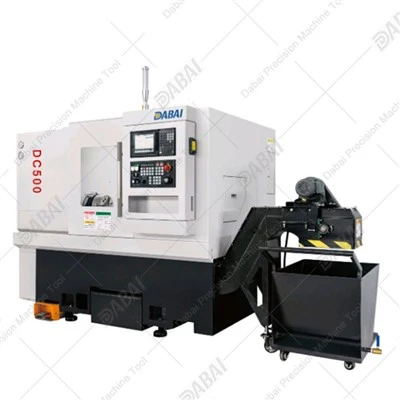
Ready to stop guessing about tool magazines and start running your shop like a well-oiled machine? Reach out to us to chat through your needs today. We can answer all your questions, break down models, and make sure you get exactly what you need, no more, no less.
Gantry Machining Center References:
- Machine Tool Manufacturing Association. (2022). High Speed Drilling and Tapping Center Operational Specifications.
- Modern Machine Shop. (2023). Tool Magazine Capacity and Its Impact on Machining Efficiency.
- VDWA Society for Production Technology. (2021). Design Considerations for Tool Change Systems in High Speed Machining Centers.
- SME. (2022). Small to Medium Batch Machining: Optimizing Tool Management for High Speed Equipment.
- US Department of Energy. (2021). Energy Efficiency in Machine Tools: Tool Magazine Capacity and Load Optimization.
Dabai Precision Machine Tool (Jiangsu) Co., Ltd.
As one of the most professional high speed drilling and tapping center manufacturers and suppliers in China, we’re featured by quality products and good price. Please rest assured to buy advanced high speed drilling and tapping center for sale here from our factory. We also accept customized orders.
Address: No. 66-1, Zhenhu North Road, Hudai Town, Binhu District, Wuxi City
E-mail: elaine@dabaicnc.com
WebSite: https://www.cnc-dabai.com/
