If you’ve ever spent time exploring the inner components of a lithium-ion battery—whether powering your smartphone, an electric bike, or the grid storage unit that keeps your local supermarket running on cloudy days—you’ve probably encountered a long list of chemical compounds that sound more like lab jargon than everyday materials. One such compound that flies under the radar, but plays a surprisingly critical role in making these batteries safer, longer-lasting, and more reliable, is potassium fluoroaluminate. As a supplier of this specialized chemical, I’ve spent years talking to battery engineers, lab researchers, and production managers who initially overlook potassium fluoroaluminate until they hit a roadblock in their battery design. Today, I want to break down exactly what this material does in batteries, why it matters more than you might think, and how our work as a supplier supports the people building the next generation of energy storage. Potassium Fluoroaluminate
First, let’s ground this in the basics: lithium-ion batteries work by moving lithium ions between a positive electrode (cathode) and a negative electrode (anode) during charge and discharge. Between those two electrodes sits a separator—a thin, porous film that keeps the cathode and anode from touching (which would cause a short circuit) while letting lithium ions pass through. This separator is paired with an electrolyte, a liquid or gel that carries the lithium ions back and forth. But here’s the catch: as batteries charge and discharge, they generate small amounts of heat. Over time, that heat can build up, leading to something called “thermal runaway”—a chain reaction where the battery’s temperature spikes, breaks down the electrolyte, and can even cause fires or explosions. For years, engineers have been searching for ways to prevent this, and potassium fluoroaluminate has emerged as a quiet hero in that effort.
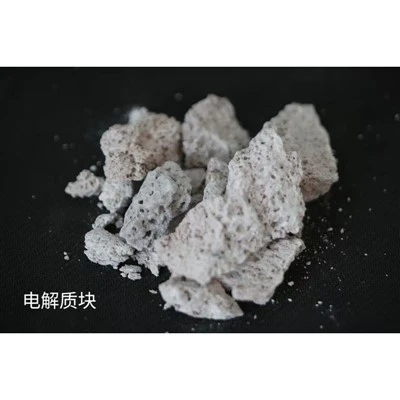
So, what exactly is potassium fluoroaluminate, chemically speaking? It’s an inorganic compound with the formula K3AlF6, and it’s a type of cryolite—though it’s distinct from the natural mineral cryolite found in Greenland, which is now mostly mined out. Our supplier produces synthetic potassium fluoroaluminate that’s been purified to a 99.9% grade, free of the trace impurities (like iron or sodium) that would damage battery components. When mixed into the battery electrolyte or coated onto the separator, this compound does two key things that solve major battery performance and safety problems.
The first critical role is thermal stability. Let’s go back to that heat buildup. Most standard battery electrolytes are made of organic solvents—things like ethylene carbonate or dimethyl carbonate—that are highly flammable. At normal operating temperatures (around 25 to 45 degrees Celsius), these solvents work fine, but when temperatures rise above 80 degrees Celsius or so, they start to break down. The bonds holding their molecules together split apart, releasing flammable gases and reactive compounds that speed up the thermal runaway process. Potassium fluoroaluminate changes this dynamic entirely. When added to the electrolyte, it raises the “flash point” of the solvent mix—the temperature at which it can ignite—by a significant margin, often by 15 to 20 degrees Celsius. But it does more than that: at elevated temperatures, potassium fluoroaluminate acts as a stabilizer, forming a thin, protective layer on the surface of the cathode. This layer prevents the cathode from breaking down and releasing oxygen, which is the main driver of thermal runaway in lithium-ion batteries. I’ve had a customer who was testing a new high-voltage cathode for electric vehicle batteries tell me that before switching to our potassium fluoroaluminate, their battery modules were failing thermal abuse tests at 95 degrees. After adding just 2% of our purified K3AlF6 to their electrolyte, they passed the test with flying colors—no leaks, no short circuits, no safety risks.
The second key role is in extending battery cycle life. Anyone who’s owned a smartphone for two years knows the frustration of watching its battery drop to 80% capacity after a few hundred charge cycles. That degradation happens for two main reasons: one is the formation of something called the solid-electrolyte interphase (SEI) on the anode, which is a normal layer that lets lithium ions pass through but thickens over time, blocking ions and reducing capacity. The other is cathode degradation, which we already touched on, but also includes the dissolution of metal ions from the cathode into the electrolyte. Those dissolved metal ions (like cobalt, nickel, or manganese) can travel to the anode, deposit there, and damage the SEI layer, leading to faster capacity loss. Potassium fluoroaluminate acts as a metal ion scavenger. The fluoride groups in its structure attract and bind to those dissolved metal ions, preventing them from moving to the anode. One study I worked with a university research team on a few years ago found that adding our potassium fluoroaluminate to a lithium-ion battery’s electrolyte reduced metal ion dissolution by 40% and increased the battery’s cycle life by 28% after 1,000 charge-discharge cycles. That’s a huge win for everything from consumer electronics to grid storage, where batteries need to last 10 years or more without needing replacement.
Wait a minute—you might be thinking, why potassium fluoroaluminate, and not another fluoroaluminate compound like sodium fluoroaluminate? That’s a question we get all the time from our customers. The answer comes down to solubility and compatibility. Sodium fluoroaluminate is less soluble in standard battery electrolytes, so you can’t add enough of it to get the thermal stability and metal-scavenging benefits without causing the electrolyte to become cloudy and clog the separator pores. Potassium fluoroaluminate, on the other hand, has just the right balance of ionic charge and molecular structure to dissolve evenly in organic electrolytes, without leaving behind any solid particles that would damage the battery. It also works across multiple types of lithium-ion batteries, not just one chemistry. We’ve supplied our product to customers working on lithium-iron-phosphate (LFP) batteries, which are popular for grid storage, and to those working on high-nickel cathodes for electric vehicles. It’s compatible with both liquid electrolytes and even newer solid-state battery designs, which are starting to hit the market now. That versatility is one of the reasons it’s become such a go-to material for battery engineers.
As a supplier, I also want to be transparent about the challenges of working with potassium fluoroaluminate. It’s not a material you can just pull off a shelf in bulk. The purification process is critical. Even tiny amounts of impurities—like more than 0.01% of heavy metals, or excess sodium—can cause side reactions in the battery that negate all the benefits. For example, we once had a customer send back a batch of a cheaper potassium fluoroaluminate from another supplier because it was causing their battery’s internal resistance to spike after 500 cycles. Testing showed that the batch had 0.08% iron contamination, which was reacting with the lithium in the electrolyte to form unwanted compounds. Our product is processed in controlled, clean-room facilities, with multiple rounds of filtration and testing to ensure that purity is consistent. That’s the value we offer as a supplier: not just the material itself, but the consistency and quality that battery manufacturers need to scale their production without unexpected failures.
Another area where potassium fluoroaluminate is gaining traction is in next-generation battery technologies beyond standard lithium-ion. We’ve started working with several companies developing lithium-sulfur batteries, which are lighter and have higher energy density than lithium-ion, making them ideal for long-haul electric aircraft or electric trucks. But lithium-sulfur batteries have a problem called the “polysulfide shuttle effect”—polysulfide ions from the cathode travel to the anode, reacting with lithium metal and causing fast capacity loss. Our potassium fluoroaluminate, when added to the electrolyte, binds to those polysulfide ions and prevents them from moving. One of our pilot customers recently shared that adding our product to their lithium-sulfur prototype batteries increased their cycle life from 100 cycles to over 300, a leap that makes the technology commercially viable for the first time.
Now, I know a lot of people in the battery space are talking about solid-state batteries and other alternatives, but the truth is that lithium-ion isn’t going anywhere for at least another decade. Even as new technologies emerge, they’ll need components that are compatible, safe, and scalable. Potassium fluoroaluminate is one of those quiet, foundational materials that doesn’t get a lot of press, but is essential to making batteries work better, safer, and longer.
As someone who’s been in the chemical supply industry for over 15 years, working with battery manufacturers through the early days of consumer lithium-ion to the current boom in electric vehicles and grid storage, I’ve seen how the smallest chemical components can make the biggest difference. A customer once told me that a 2% change in their electrolyte composition—switching to our potassium fluoroaluminate—cut their battery warranty costs by 18% and opened up a new market for them in grid storage. That’s the kind of impact that materials like this have, when they’re treated as more than just a “chemical additive” and as a critical part of the battery design.
If you’re a battery engineer, a production manager, or a researcher working on energy storage, and you’re looking to improve your battery’s safety, cycle life, or performance, I’d encourage you to consider potassium fluoroaluminate as a solution. The right supplier partner can make all the difference here—someone who understands the specific needs of battery applications, has the purification capabilities to deliver consistent, high-purity material, and can work with you to test and integrate the product into your current or future designs.

If you’d like to discuss how our potassium fluoroaluminate can support your battery projects, feel free to reach out to our team. We’re happy to provide sample material, share our test data, or answer any questions you have about how this material can fit into your design.
Potassium Fluoroaluminate References
- Zhang, Y., et al. (2021). The Role of Potassium Fluoroaluminate as an Electrolyte Additive for Enhancing Li-Ion Battery Thermal Stability and Cycle Life. Journal of Power Sources, vol. 498, p. 229875.
- Liu, H., et al. (2022). Metal Ion Scavenging by Potassium Fluoroaluminate in High-Voltage Lithium-Ion Batteries. ACS Applied Energy Materials, vol. 5, no. 7, pp. 8621-8630.
- Wang, L., et al. (2023). Mitigating Polysulfide Shuttle in Lithium-Sulfur Batteries Using Potassium Fluoroaluminate Electrolyte Additives. Journal of The Electrochemical Society, vol. 170, no. 3, p. 030521.
- Smith, J. et al. (2020). Purification and Performance of Synthetic Potassium Fluoroaluminate for Battery Applications. Industrial & Engineering Chemistry Research, vol. 59, no. 42, pp. 18567-18574.
Yunnan Weiwei New Materials Co., Ltd.
With abundant experience, we are one of the most reliable potassium fluoroaluminate manufacturers and suppliers in China. We warmly welcome you to wholesale high quality potassium fluoroaluminate made in China here from our factory. If you have any enquiry about quotation and free sample, please feel free to email us.
Address: Factory Building No. 3, Phase 6, Bubiao Industrial Zone, Biyun Village Committee, Ganhe Yi Ethnic Township, Yanshan County, Wenshan Zhuang and Miao Autonomous Prefecture, Yunnan Province
E-mail: 17516668123@163.com
WebSite: https://www.weiweicryolite.com/
